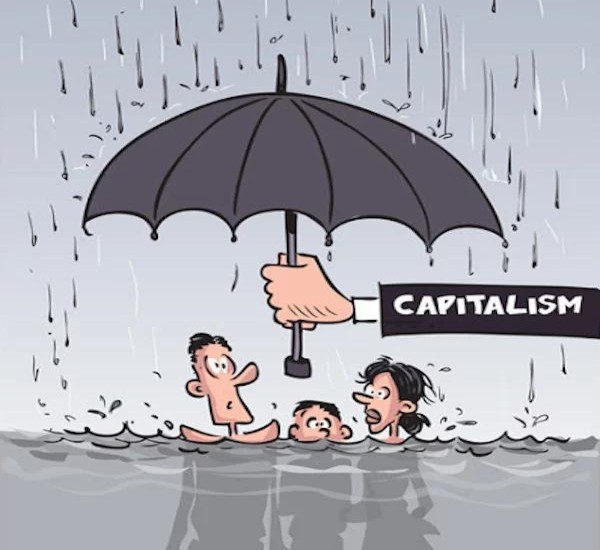
Liberal capitalism tends to remove all rules from the free market. It aims to name capital as the ultimate value in society to which all need to obey, and, if possible, the only value. It is understandable that those with capital strongly support liberal capitalism, as it gives them ultimate power in society. Today, everything is about power over others, which is why we live in such a destructive environment.
As a result of the free market, stronger producers tend to win, while weaker ones tend to lose. Losers in liberal capitalism are subject to a much worse position than a well-oriented society would allow. Unemployed people cannot earn a living. Additionally, unemployed individuals often accept low-paying jobs to make ends meet. That increases income disparity among people. Those who do not have enough money cannot afford to purchase much, while those who have too much money do not need to purchase much because they already have a lot. The market falls, and the economy plunges into recession and crisis. That is precisely what we have today. Liberal capitalism significantly contributes to today's unsustainable economy.
Liberal capitalism also works hard to suppress the regulation of production processes, which pollute our world, creating an unhealthy environment. The lack of proper regulation lets producers make unhealthy food. For example, the meat industry prevents animals from getting sick by giving them antibiotics. When we eat meat, we consume enough antibiotics that bacteria in our bodies become resistant to them and cannot be eliminated. In the future, antibiotics may no longer cure us. Or we protect crops from parasites by using pesticides and other poisons. They make us ill. Most cancer cases occur from eating poisonous food. The Canadian Cancer Society predicts that every other person will get ill from cancer. Statistically, that means between the two of us, dear reader, one will get cancer. Paradoxically, producers also consume the same food because earning money matters more to them than their own health.
I hope most readers here understand that we have to regulate capitalism. However, we must establish sensible rules. My philosophy holds that the only reasonable solution for society is equal human rights. Once society establishes equal human rights, it will inevitably become better. I explain this in detail in my book Humanism. Society cannot impose equal human rights. Society needs to understand the benefits of equal human rights and requires time to accept them so that they can be established gradually.
In the economy, establishing equal human rights must begin with everyone's right to employment opportunities. If opening new work posts is not needed, full employment will be achieved by shortening work hours in proportion to the unemployment rate. Once unemployment is eliminated, employers will have to compete to hire workers, and they will do so by raising salaries. The fair market will regulate everything well. UBI or unions will no longer be needed. Workers will earn more and be able to purchase more, thereby stimulating economic growth. The whole society will benefit. I wrote more about it in the article: Let’s remove unemployment.
The pursuit of production greed cannot come at the expense of our health. We need to establish much stricter production regulations than those currently in place. We need to eliminate poisons in the food industry. This will make us much healthier. However, we do not need to rely solely on a strong bureaucracy. My new idea will help political systems be more efficient. The idea is based again on equal rights for all people. Let’s give everyone equal power to evaluate, say, three people positively and three people negatively each month. Let a positive evaluation bring small awards to the evaluated person, and a negative evaluation bring minor punishments. That would, for the first time, put a small direct power in the hands of the people. I have called it democratic anarchy and written more about it in the article "The Future of Democracy."
What would we achieve with it? Directing people’s involvement in judging others would also help protect our environment, as people would likely punish those who pollute it. That will protect the environment more. However, this evaluation system will improve society significantly. People will start respecting other people equally. People will become the values of all people. They will all work hard to produce the greatest possible advantages for society and to diminish or even abolish all forms of disadvantage. That will create a good society unconditionally and unavoidably. The improvement of society will not stop there; people will continue improving society until it becomes fantastic and even better. People may learn through their own practice what they should and should not do in life, so laws may no longer be needed.
Equal human rights are the foundation for building a good society. They are the missing part in the history of humankind which has prevented society from being well. Once they are established, evil will be eradicated from the surface of planet Earth, and a bright future for humankind will begin. Outlining what equal human rights would look like to achieve such an improvement makes me a messiah.